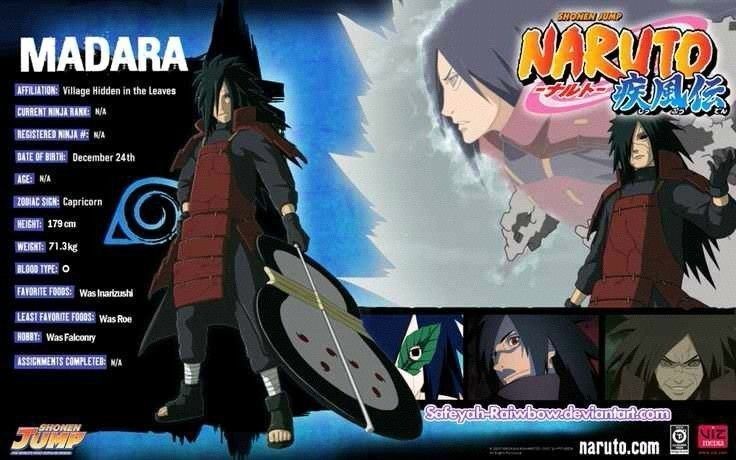
Long Character Biography
Madara Uchiha was born into a time of war, where clans battled continuously for survival and dominance. From an early age he demonstrated ferocious talent and an indomitable will; these traits made him a natural leader of the Uchiha. His childhood and youth were defined by loss, battle, and a continual test of the values that would guide his life. Out of this crucible came a warrior who prized strength as a means to protect what he loved, but who also developed a deep mistrust of political institutions that, in his view, betrayed the sacrifices of warriors.
Madara's path became intertwined with Hashirama Senju's: two leaders from historically opposed clans who nonetheless shared a dream-an end to the endless cycle of clan warfare. For a time they cooperated to create Konoha, hoping to establish an ordered society built on trust rather than perpetual conflict. Over time, however, Madara grew disillusioned. He believed that the centralization of power and the compromises that followed eroded true justice and marginalized powerful clans like the Uchiha. Where Hashirama believed in reconciliation and shared governance, Madara increasingly saw a harsher reality: a world where ideals must be enforced, not negotiated.
Madara's disillusionment hardened into a plan of almost cosmic ambition. He pursued and mastered forbidden secrets-perfecting the Sharingan and later awakening the Rinnegan-to gain the means to impose an enforced peace. He conceived the Eye of the Moon Plan: using the power of the Ten-Tails and the moon to cast a worldwide illusion that would place humanity into a dreamlike state, free from pain and conflict. In Madara's mind this coercive peace was the only truly reliable solution to humanity's repeating tragedies. His methods were ruthless; he chose ends over consent and substituted control for genuine reconciliation.
Even after death and multiple resurrections, Madara's influence was staggering. He catalyzed the Fourth Great Ninja War, exposed deep manipulations that had shaped shinobi politics for decades, and forced protagonists to confront the moral boundaries of their own convictions. His life and ambitions ask a chilling question: can peace be just if it is imposed without the consent of those it binds? Madara's eventual defeat does not erase the urgency of that question; instead it highlights the series' preference for choice, empathy, and shared responsibility over unilateral domination.
Role in the Anime
Madara functions as the archetypal antagonist whose vision scales the conflict from national politics to metaphysical worldbuilding. His mastery of legendary techniques and his status as a founding figure give him narrative weight: he is not merely a powerful enemy but a symbolic endpoint for problems that have accumulated across generations. As such, he serves both as a final test of strength and as an ideological counterpoint to Naruto, Sasuke, and other characters who argue for change through bonds rather than enforced illusion.
In addition, Madara's revelations and maneuvers unmask institutional failure: the series uses his actions to expose how historical revision, secrecy, and elite decisions corrupted the path to peace. In battles, he operates as a nearly unstoppable force whose existence requires global cooperation to confront-thereby uniting once-warring factions to act together.
Contribution to Plot
Madara's resurrection and subsequent campaign precipitate the series' climactic events. By orchestrating the revival of the Ten-Tails and seizing unprecedented power, he creates the conditions for the Fourth Great Ninja War-an event that forces every major faction to choose sides and redefine alliances. The war functions as the narrative crucible in which characters reveal their true values and in which the ideological debate over peace-force versus reconciliation-plays out on a global scale.
Madara's influence is also catalytic in character growth. His extreme choices push Naruto, Sasuke, and others to refine their moral arguments and to demonstrate the limits of force. Ultimately, his defeat helps validate a different path: one rooted in consent, repairing relationships, and structural reform rather than the imposition of a dream-state peace.
Special Abilities
- Sharingan Mastery - Exceptional ocular ability granting prediction, genjutsu, and copying techniques with terrifying precision.
- MangekyÅ & Eternal MangekyÅ Sharingan - Access to devastating ocular techniques and, after transplantation, a stable, powerful form that avoids blindness.
- Rinnegan - Grants a suite of godlike abilities: manipulation of life/death processes, absorption of chakra-based attacks, and mastery over space–time phenomena when used with specific techniques.
- Susanoo (Perfect Form) - A massive, chakra-formed avatar that serves as both impregnable armor and a platform for world-shaking offensives.
- Control Over the Ten-Tails - At his apex, Madara can harness the Ten-Tails' power, enabling planet-scale energy manipulation and the creation of the Infinite Tsukuyomi.
- Immense Tactical Intellect - Beyond raw power, Madara is an exceptional strategist who engineers long-term plans spanning decades.