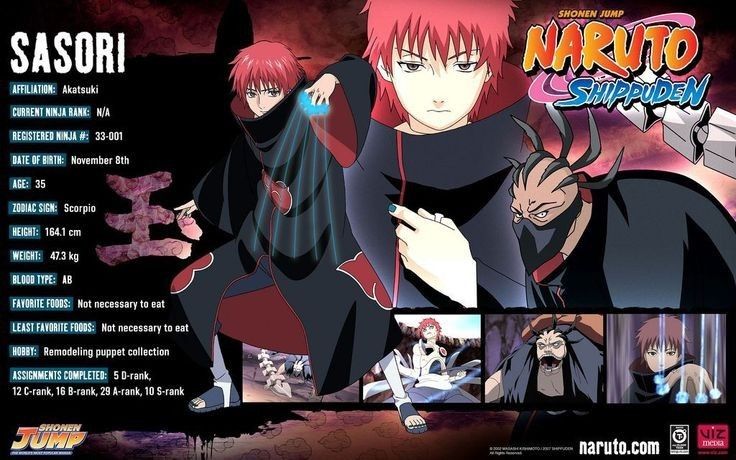
Long Character Biography
Sasori was born in Sunagakure (the Village Hidden in the Sand) during a period where warfare and survival shaped everyday life. From a very young age he displayed a profound aptitude for puppet techniques, and his mother's death became a formative trauma that shifted his view of life and art. Unable to accept the fragility of life, Sasori turned to puppetry as both craft and coping mechanism: by transforming living beings into puppets preserved forever, he sought to arrest the decay inherent to mortality. His obsession with permanence eventually led him down a dark path of experimentation, culminating in the radical decision to convert his own body into a puppet-abandoning human flesh in favor of mechanical immortality.
As a puppet master, Sasori's talents reached legendary status. He created a vast arsenal of human puppets-many of them made from the bodies of feared shinobi-each retaining aspects of their original abilities. This gruesome art elevated his status among Sunagakure's elite and later attracted the attention of Orochimaru and the Akatsuki. Sasori joined the organization as a means to accomplish his work on a larger scale and to pursue aesthetic perfection through controlled destruction. He partnered with Deidara in Akatsuki operations, a pairing that underscored an artistic rivalry: Sasori sought permanence in art, while Deidara exalted transient explosion. Their philosophical conflict enriched the narrative and highlighted different responses to loss and artistic purpose.
Despite his monstrous exterior and cold demeanor, Sasori was more than a one-note villain. He was reflective and often melancholic-capable of introspection about the cost of his choices. In the Chunin Exam and later arcs, Sasori's actions-such as capturing Kankuro's mentor and attempting to steal the Third Kazekage's secrets-served to expose vulnerabilities in the political and protective structures of the shinobi world. His eventual showdown with Sakura and Chiyo is as much an ethical reckoning as it is a tactical duel: the battle reveals the human cost of Sasori's pursuit of perfect art and the painful reality of memory, identity, and preservation.
In the end, Sasori's death is both tragic and revealing; it denies him the immortality he sought in human skin and instead forces a posthumous confrontation with his lost humanity. The defeat includes moments that humanize him-his fond recollections of his grandmother, his brief recognition of Chiyo, and a final acceptance that art cannot perfectly substitute for living connection. Through Sasori, the series interrogates the nature of legacy: whether it is better to preserve the past by freezing it or to accept change and allow memories to inform the living.
Role in the Anime
Sasori functions as both a formidable antagonist and a thematic instrument. His mastery of puppetry and use of human puppets provide some of the most visually and emotionally striking battles in the series. As an Akatsuki member, he furthers the organization's goal of capturing jinchuuriki and destabilizing shinobi nations. On a deeper level, Sasori's obsession with permanence sets him up as a foil to characters who embrace bonds and change-such as Sakura, who ultimately repairs and honors human life rather than freezing it.
He also reveals political and moral fragilities within the Sand Village and shows how personal grief can be manipulated into cold ideology. His presence escalates the stakes for Team 7 and their allies and provides crucial growth opportunities for Sakura, Chiyo, and other supporting characters.
Contribution to Plot
Plotwise, Sasori's kidnapping of the Third Kazekage's secrets and his kidnapping of Gaara's assistant frame several key developments: they expose the vulnerability of the village and prompt rescue missions that demonstrate the strength of allied bonds. The battle where Sakura and Chiyo confront Sasori is pivotal-it is a major emotional turning point for Sakura, who matures into a powerful medical-nin and fighter through this victory.
Moreover, Sasori's death yields crucial intelligence about Akatsuki and the organization's methods. Through his defeat, the allied forces learn more about puppet-based warfare, human puppet technology, and the depth of experimental methods used by sinister actors like Orochimaru. Sasori's demise is both a tactical and symbolic victory for the protagonists.
Special Abilities
- Master Puppeteer - Sasori can control dozens of puppets simultaneously with unparalleled finesse, using chakra strings to animate complex multi-layered attacks.
- Human Puppets - He creates puppets from living humans, preserving their abilities; his puppet of the Third Kazekage could reproduce powerful iron sand and unique techniques.
- Self-Puppet Body - Sasori converted much of his body into a puppet, concealing organs and survival mechanisms in a puppet core that grants durability and hidden weaponry.
- Poison Mastery - His arsenal includes lethal poisons applied to puppet weapons and traps, capable of incapacitating or killing enemies even after initial contact.
- Remote Weaponry & Traps - Sasori's puppets integrate dozens of hidden blades, explosives, and ranged weapons that can be deployed rapidly and strategically.
- Strategic Memory & Mimicry - Having converted real shinobi into puppets, Sasori acquired an encyclopedic record of enemy techniques and battle styles, enabling targeted counters.