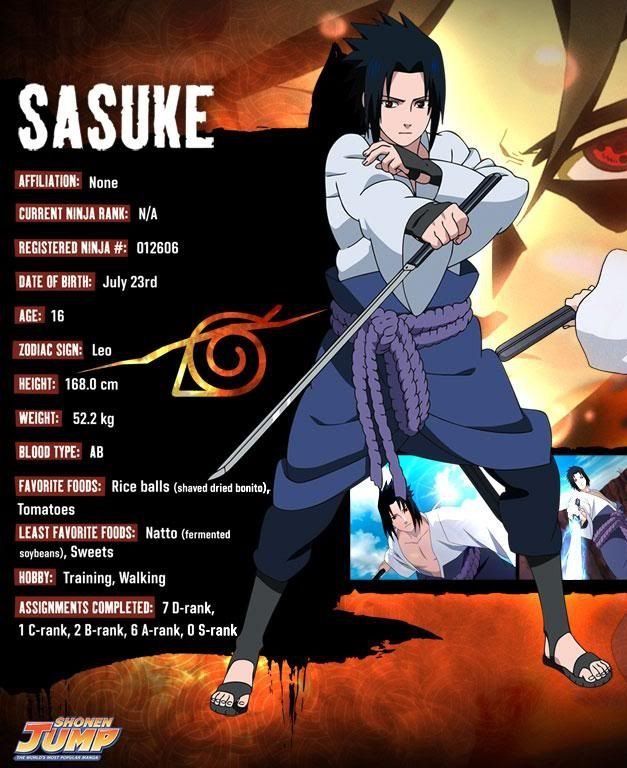
Character Biography
Sasuke Uchiha is introduced as the last scion of the esteemed Uchiha clan, a prodigious ninja whose calm, aloof demeanor masks deep trauma and ambition. As a child he excelled academically and in training, admired by mentors and peers alike. His life was irrevocably altered when his entire clan was massacred-an event for which his elder brother Itachi was publicly blamed. That moment becomes the defining trauma of Sasuke's youth: it establishes a single-minded quest for vengeance that eclipses other human needs. He becomes consumed by the idea that in order to avenge his family he must obtain incomparable power, even at the cost of friendships and moral compromise.
Early on, Sasuke's relationships-especially with Naruto, Sakura, and Kakashi-shape his path. Naruto's unyielding desire to bring Sasuke back, and Sakura's emotional investment, create a persistent tension between bonding and isolation. Sasuke initially uses teamwork pragmatically, but his hunger for strength compels him to leave Konoha, pursue training under Orochimaru, and adopt increasingly ruthless measures. During his exile he absorbs forbidden knowledge, cultivates lethal skills, and grows colder-becoming a figure who believes the end (justice for his clan) justifies any means.
As Sasuke learns more about the political manipulations surrounding the Uchiha massacre and the larger machinations of figures like Danzo and Tobi, his philosophical stance evolves. His anger broadens into ideological disdain for the hidden systems of power; he ultimately attempts to impose radical change-first seeking to destroy those he sees as corrupt and later to reconstruct the world according to his own terms. Despite his turn toward extremism, Sasuke is not irredeemably malevolent. He remains emotionally complex: haunted by memories of his family, haunted by Itachi's true motives after learning them, and gradually confronted by Naruto's persistent attempts to reclaim him. By the series' end Sasuke chooses a path of atonement-undertaking a long journey of restitution and quietly protecting the village from the shadows-demonstrating a hard-earned, if tentative, reconnection to humanity.
Role in the Anime
Narratively, Sasuke functions as both foil and engine. He provides a dark mirror to Naruto: where Naruto responds to suffering with empathy and connection, Sasuke often retreats into solitude and the pursuit of force. This contrast fuels much of Naruto's development-Naruto's desire to save Sasuke forces him to mature, strategize, and take moral responsibility. Sasuke also drives several major plotlines: his defection catalyzes rescue arcs, his alliances with dangerous figures escalate stakes, and his later actions shape the political and metaphysical endgame of the series.
Sasuke's interpersonal role is equally meaningful: his relationships to Sakura, Naruto, and mentors create emotional tension that the story uses to explore themes of loyalty, pain, and redemption. His intellectual and tactical brilliance makes him a pivotal battlefield presence who can shift the outcome of major conflicts.
Contribution to Plot
Sasuke's pursuit of vengeance provides key narrative momentum-his defection to Orochimaru initiates a sequence of missions and emotional crises that test the bonds of Team 7. Later, his alignment with (and manipulation of) larger antagonists draws the shinobi world into broader conflict and ideological debate. Many climactic confrontations-particularly the final Naruto vs. Sasuke battles-are not merely physical contests but moral reckonings that determine the ideological future of the ninja world.
In the end, Sasuke's eventual repentance and decision to take responsibility in a quieter way (by protecting the world while atoning) completes an arc that moves the series from vengeance-driven tragedy toward a vision of restoration. His choices force other characters to confront the cost of retribution and the possibilities of reform.
Special Abilities
Sasuke's powers evolve significantly across the series. Below are his key abilities with descriptions concise enough for study and presentation.
- Sharingan - A Kekkei Genkai of the Uchiha clan, the Sharingan grants Sasuke heightened perception, the ability to read and predict movements, and the capability to copy many ninjutsu techniques.
- Mangekyō Sharingan - An advanced form of the Sharingan that unlocks unique, high-level techniques. Sasuke's Mangekyō enables intense genjutsu and offensive abilities, but its use strains the user's eyesight and stamina.
- Amaterasu - A Mangekyō ability that produces inextinguishable black flames which burn targets on a molecular level. Sasuke uses Amaterasu tactically, often in conjunction with his Susanoo or other techniques.
- Susanoo - A giant, chakra-formed warrior that surrounds and defends Sasuke, acting both as offense and defense. Susanoo can wield weapons and project devastating energy attacks.
- Chidori & Variants - A high-speed, lightning-nature thrust developed under Kakashi's tutelage. Sasuke improves and diversifies it into multiple forms (Chidori Stream, Chidori Senbon) for precision and power.
- Curse Mark & Orochimaru-derived Upgrades - During his training under Orochimaru, Sasuke temporarily uses the Curse Mark to boost power, speed, and resilience at the cost of potential loss of control.
- Rinnegan (later stages) - In advanced arcs, Sasuke obtains Rinnegan-like powers that expand his range dramatically-permitting space–time techniques, teleportation/shifting of fields, and powerful ocular-based attacks.
- Kenjutsu & Tactical Genius - Beyond ocular powers, Sasuke is a master swordsman, adept at tactical readjustment and quick decision-making in battle, using a mixture of physical skill and ocular dominance.